
No Drill Wall Storage for Renters

The short answer: check the door swing and the floor footprint before you commit. No method here is truly damage-free, so read the maker's own removal instructions before anything touches the wall.
No-drill storage is not one method. An over-door rack depends on door fit. A tension system depends on the location named by its maker. Leaning storage needs a stable footprint. Removable adhesive depends on the exact product, surface, preparation, and removal instructions. Treating all four as interchangeable is how a renter buys the wrong system.
This guide uses a compatibility sequence rather than a damage ranking. Start with the place that must stay usable, then check whether the storage method belongs there. No option is described as damage-free, and no choice should be installed from a general inspiration photo alone.
Define the storage zone before the product
Name the objects first. A few light accessories, folded clothing, bags, and daily tools create different access needs. Then mark what the zone already does: a door opens, a walkway passes, a curtain moves, or a drawer needs room. Storage loses when it interrupts that existing action.
Use a temporary outline made from paper or removable painter's tape that is suitable for your surface. Open the door, reach for the object, and walk the normal route. The outline is not a product test. It simply reveals whether the proposed location is already too busy.
Compare compatibility, not promises
| Method | Check first | What it can solve | Reason to reject it |
|---|---|---|---|
| Over-door | Door thickness, top gap, handle, and full swing | Uses the door plane without drilling the wall | The door no longer closes or the rack collides with furniture |
| Tension-pole | Manufacturer-approved contact points and available footprint | Adds vertical organization in a defined zone | The actual location is not supported by the product instructions |
| Leaning storage | Stable floor contact and the space it occupies | Keeps the wall free of drilled fixings | It narrows the route or cannot stand securely in that position |
| Removable adhesive | Exact product, finish, preparation, and removal instructions | Holds suitable small items where the maker permits | The surface or use is not explicitly supported |
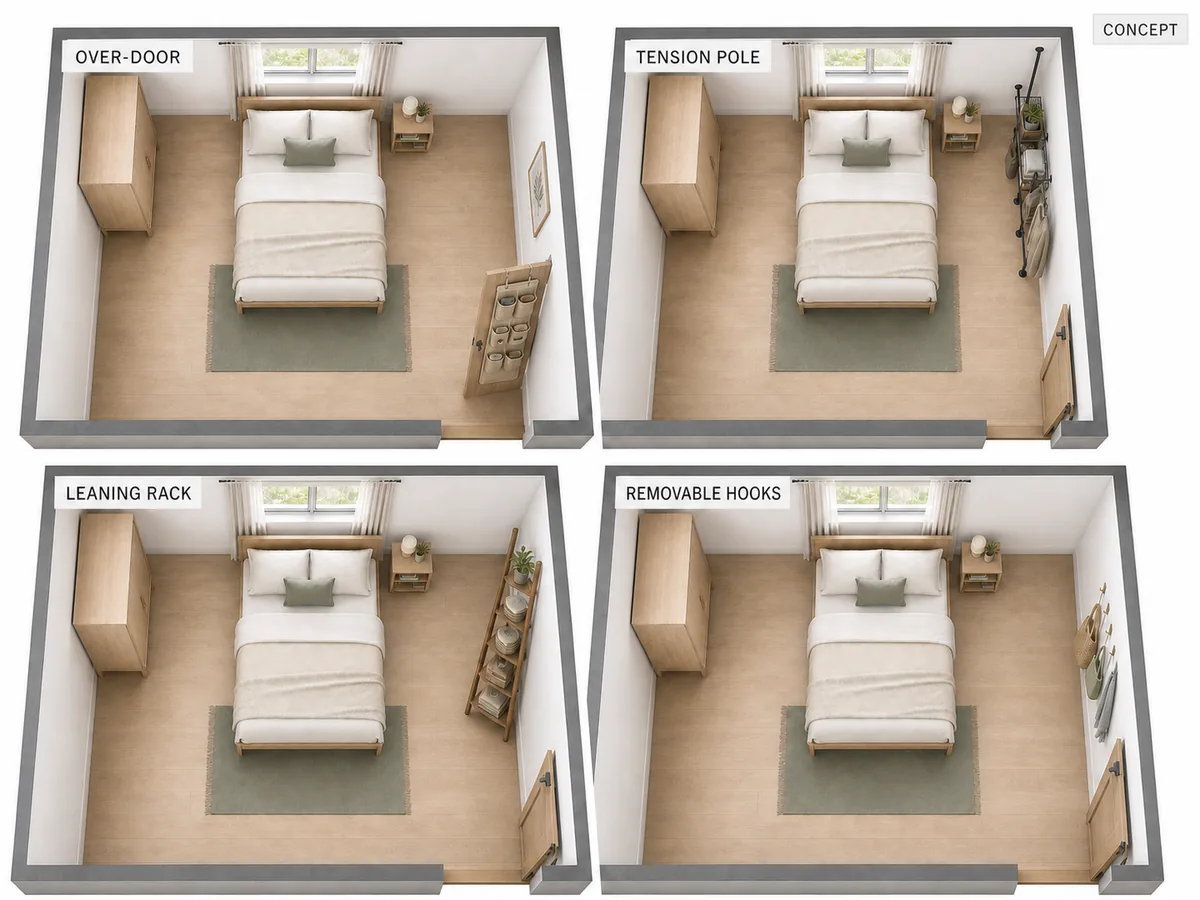
CONCEPT: AI-generated room concept; not a photograph, measured floor plan, or damage guarantee.
Check an over-door system with the door moving
Test the door in both directions it normally travels. Look at the top clearance, the latch, the handle, and any furniture near the swing. A rack that fits while the door is still may fail when the door closes or when stored items project into the room.
Do not correct a bad fit by forcing the door or adding unverified padding. If the rack changes normal door operation, reject that location. The useful feature of over-door storage is reversibility; once it makes the door unreliable, the tradeoff is no longer convincing.
Use tension only where the maker supports it
A tension-pole system may look independent of the wall, but it still relies on contact points and a stable setup. Read the current instructions for the exact product before treating a corner, ceiling zone, or opening as compatible. A photograph of a similar room is not evidence for your surface or location.
Map the footprint as well as the vertical reach. If the base occupies the route beside the bed or blocks a drawer, moving storage upward has not solved the floor problem. Reject the placement when the system needs an improvised contact point or when normal use would push through its footprint.
Judge leaning storage by the floor it consumes
Leaning storage avoids a drilled installation, but it is still furniture. It needs floor area, a sensible angle, and a location where daily movement will not knock into it. Test the empty form first and do not infer stability from appearance.
This method can suit visible categories that you reach often. It is less convincing in a narrow passage or behind a moving door. If it makes the route feel smaller than a freestanding cabinet would, the visual lightness is not a functional gain.
Treat removable adhesive as product-specific
Generic adhesive advice is unreliable because products and finishes differ. For one named example only, Command's official instructions say to wait 7 days after painting, press the hook for 30 seconds during the stated installation sequence, and wait 1 hour before use. Those timings belong to that referenced Command system. They are not universal rules for other adhesives, surfaces, hooks, or storage products.
Follow the complete current manufacturer instructions, including preparation, supported surfaces, use exclusions, and removal. Do not combine a strip with an unlisted container and assume the system keeps the same behavior. When the actual surface or intended use is not supported, choose another method rather than inventing a test.
Use the compatibility sequence
- Keep the door working. Reject over-door storage that changes closing, latching, or the normal swing.
- Keep the route open. Reject tension and leaning systems that move a wall problem onto the floor.
- Keep instructions specific. Reject adhesive use that cannot be traced to the exact maker, product, surface, and application.
- Keep the change reversible. Do not describe an option as safe for a lease or deposit; confirm permissions yourself before use.
Start with the furniture route in the small bedroom layout ideas guide. Put categories below the bed first when the under bed storage ideas for small rooms decision matrix fits them. Keep the chosen wall zone usable after dark with small bedroom lighting ideas for renters. If what the room actually needs is a work surface rather than storage, check first whether a desk can win a position on the floor with small bedroom desk layout ideas.