
Under Bed Storage Ideas for Small Rooms
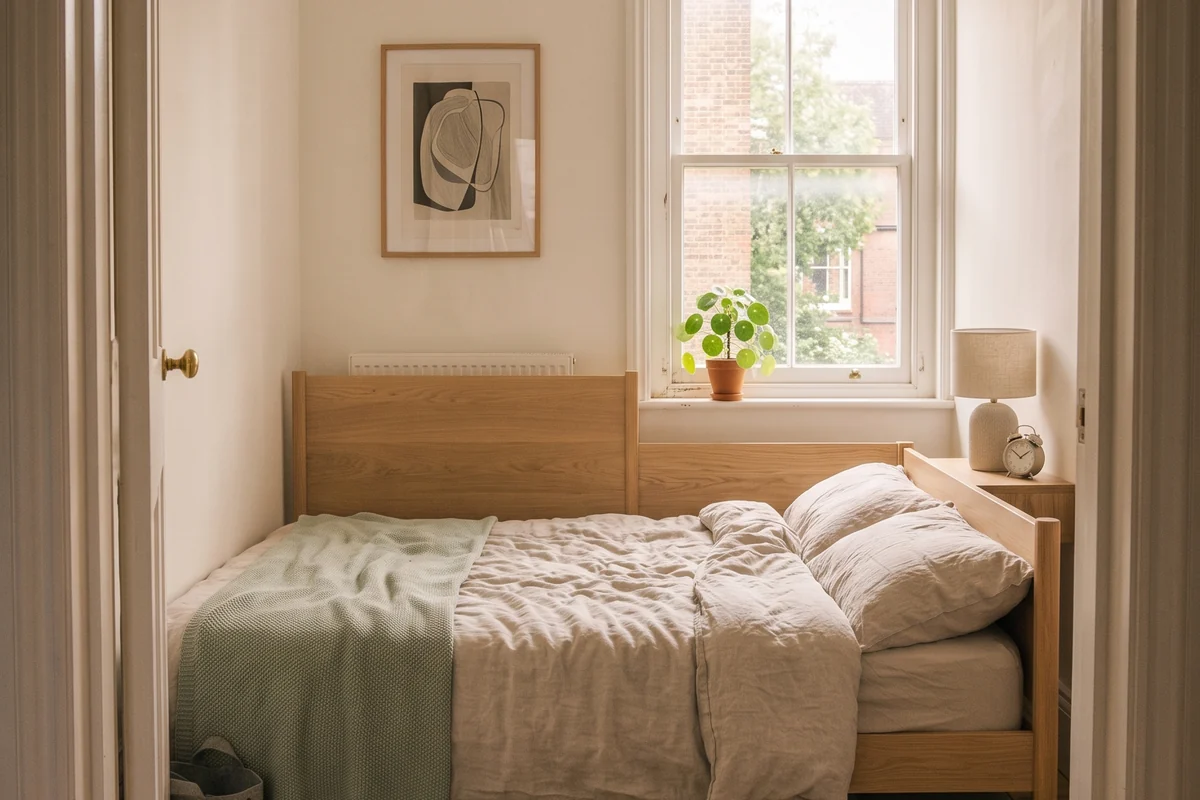
The short answer: measure the frame opening at its tightest point before you choose a container. A pull-out drawer is the best default for anything you reach for weekly. The other three options win only in a specific situation, and this guide names which.
Under-bed storage fails when the container is chosen before the frame is checked. A deep bin may look efficient online but stop at a center rail. A drawer may fit below the mattress yet have nowhere to open. Start with the items you need, the opening you actually have, and the way the container must move across your floor.
This guide compares four under bed storage ideas for small rooms: drawers, lidded bins, soft bags, and lift-up storage. The best default for frequently used items is a pull-out container you can open without moving the bed. The other options win only when dust, floor friction, or access frequency changes the decision.
Map the frame before choosing a container
Remove one item from below the bed and inspect the complete opening. Look for center legs, cross rails, low side rails, loose fabric, and anything stored from the opposite side. If you find a center support beam running through the space, the decision changes shape and the guide for it is under bed storage with a center support beam. Then slide a flat piece of cardboard through the route a container would take. If the cardboard catches, a rigid box is likely to catch too.
Measure the frame rather than relying on the mattress label. As one product-specific example, IKEA lists the NEIDEN Full bed frame at 54.75 inches wide and 76.75 inches long, with 7.875 inches under the furniture. Those figures describe that named frame only. They do not prove that a particular bin fits, because rails, handles, lids, wheels, and floor movement still affect the usable opening.
The practical question is not how much empty volume appears below the mattress. Ask whether the storage can enter, turn, open, and come back out while the surrounding furniture stays in place.
If that opening turns out to be tight rather than merely awkward, the decision changes shape and the comparison below stops being the right tool. Work from a height budget instead, using under bed storage for low clearance frames.
Compare the four storage types
| Storage type | Best for | Main gain | Main tradeoff | Keep or reject |
|---|---|---|---|---|
| Pull-out drawer | Clothing or linens reached often | Fast access and visible categories | Needs a clear pull path | Keep when it opens without moving another object |
| Lidded bin | Seasonal or dust-sensitive items | Closed protection and easy stacking before loading | Rigid corners expose every frame obstruction | Keep when the complete box passes the cardboard test |
| Soft bag | Light textiles and awkward openings | Flexible sides can pass around minor obstructions | Shape collapses and contents are harder to scan | Keep for light items you do not need every day |
| Lift-up storage | Infrequent items and frames designed for lifting | Access without a side pull path | Requires opening the bed itself | Keep only when the frame is designed for that action |
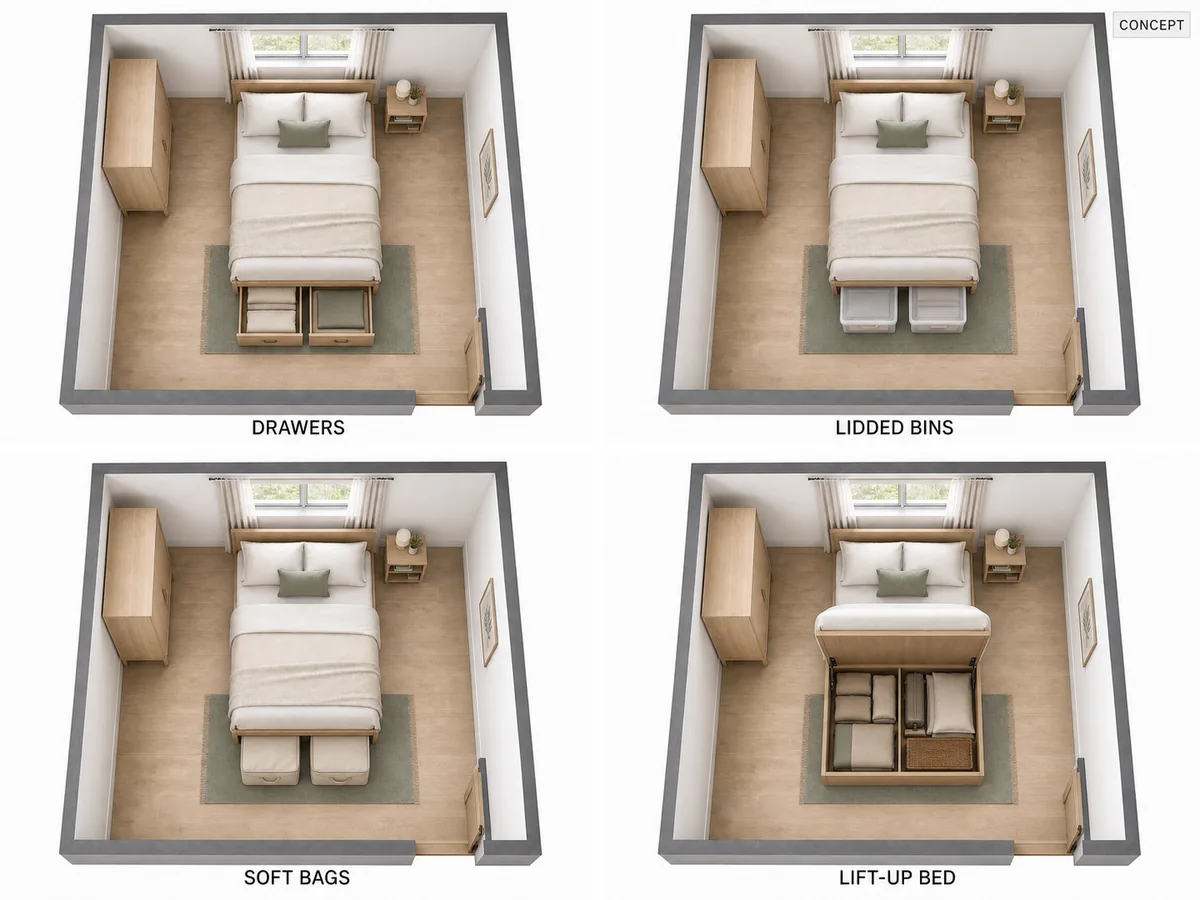
CONCEPT: AI-generated room concept; not a photograph or measured floor plan.
Choose drawers for repeat access
A drawer is the strongest default when you reach for the contents often. It gives each category a visible place and avoids lifting a lid in a tight gap. Test the full action before buying: pull, open, reach, close, and return. A drawer that stops halfway turns a simple task into a sequence of furniture moves.
Do not assume wheels solve every floor problem. A wheel can catch in a rug edge, while a wide smooth base may drag on a soft surface. Test the movement with a temporary box carrying a similar type of load. The aim is not maximum capacity. It is one clean action from closed to usable.
If your floor is carpeted, the movement question deserves its own answer, because pile changes which base wins rather than just how hard it is to pull. See under bed storage on carpet.
Use lidded bins when dust control matters more than speed
A lidded bin suits items that can stay out of sight for longer periods. The rigid shell keeps its shape and makes categories easier to label. That same rigidity is its weakness: the bin cannot bend around a center support or squeeze below a low rail.
Choose the entry side before filling the bin. If the only route is beside a wardrobe or nightstand, rehearse the pull with those pieces in their normal positions. Reject the bin if it needs the bed or another heavy object to move first. Storage is not useful when accessing it becomes a room reset.
Use soft bags for light items and irregular openings
Soft bags can work where a rigid corner would catch. They are most convincing for spare bedding, off-season fabric, or other light items that tolerate compression. They are less useful for mixed small objects because the shape changes as the bag moves and the contents become difficult to scan.
Keep each bag to one category. A label on the pull end prevents every bag from being opened during a search. Avoid packing it so tightly that the flexible advantage disappears. If the bag becomes a hard block, it should be tested like a bin.
Treat lift-up storage as a frame decision
Lift-up storage is not an accessory to improvise beneath an ordinary bed. It belongs to a frame designed for that movement. It can remove the need for a side pull route, but the whole opening action must remain practical in the room.
Use it for items that do not need constant access. If a bedside table, lamp, or loose object must move before the bed can open, include that friction in the decision. The storage may hold more while still making the room harder to use.
Run the keep, move, or skip check
- Keep the option when it passes through the real frame opening and completes one access cycle without moving other furniture.
- Move the category to a different container when dust protection, visibility, or access frequency does not match the first choice.
- Skip the purchase when the opening is uncertain, the floor route catches, or the storage duplicates space you already avoid using.
Solve the furniture route first with the small bedroom layout ideas guide. If the bed cannot carry the category, compare no drill wall storage for renters. Keep the pull route visible after dark with small bedroom lighting ideas for renters.