
Small Bedroom Desk Layout Ideas
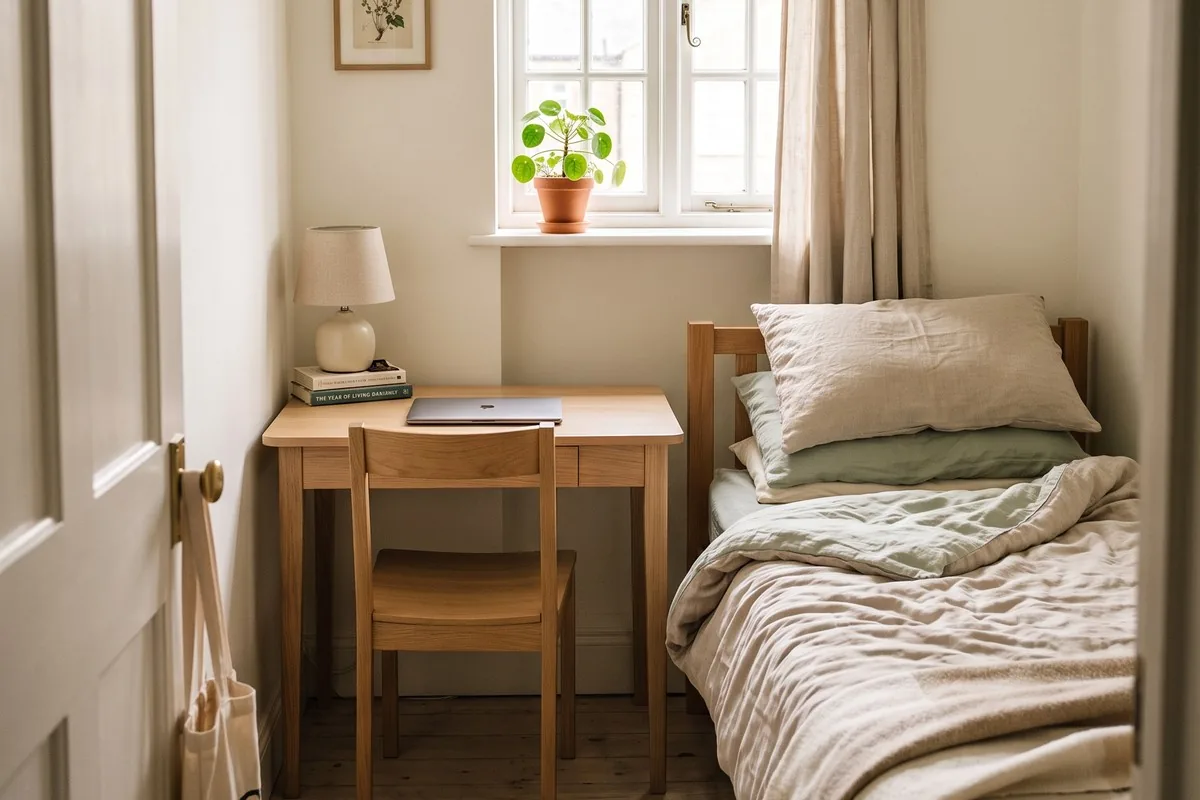
The short answer: The desk is rarely what fails to fit. Measure how far your chair has to travel back before you can stand up, add that to the desk depth, and test the total against the bed route and the door swing before you buy anything.
A desk stops fitting a small bedroom long before the desk itself is too big. What runs out of room first is the chair.
A desk is a static object. A chair is a moving one, and it needs a volume of empty floor that only exists while you are using it. Almost every desk-in-a-small-bedroom guide sizes the desk. This one starts from the movement, because that is what actually fails.
Protect the bed route and the door swing first
Two routes in a bedroom are not negotiable. You have to be able to get into the bed, and the door has to open fully. Anything a desk does to either one of those will be paid for every single day, and no amount of useful work surface buys it back.
Work out the real footprint before you shop. IKEA publishes the MICKE desk at 28.75 inches wide and 19.625 inches deep. That describes that one named desk and proves nothing about any other. But the depth figure is the instructive one, because 19.625 inches is the *static* depth. The working depth is that number plus however far your chair has to travel backwards before you can stand up.
That second distance depends entirely on the chair you already own, so measure it rather than trusting a number from anyone, including us. Put the chair at a table, sit down, then push back until you can stand normally. Mark the floor. That distance, added to the desk depth, is the space the layout has to find.
Then lay it out in cardboard on the actual floor, with the wardrobe door and the bed where they really are, and walk the bed route in the dark. A desk corner that is invisible at midday is a bruised shin at two in the morning. Measured bed-and-desk plans by room size: 7x10 bedroom layout, 8x8 bedroom layout, 8x9 bedroom layout, 8x10 bedroom layout, 8x11 bedroom layout, 8x12 bedroom layout, 9x9 bedroom layout, 9x10 bedroom layout, 9x11 bedroom layout, 9x12 bedroom layout, 9x13 bedroom layout, 10x10 bedroom layout, 10x11 bedroom layout, 10x12 bedroom layout, 10x13 bedroom layout, 11x11 bedroom layout, 11x12 bedroom layout, 11x13 bedroom layout, 12x12 bedroom layout. A king bed, measured room by room: 10x10 bedroom, 10x12 bedroom, 11x12 bedroom, 12x12 bedroom, 12x13 bedroom, 12x14 bedroom, 13x13 bedroom.
Compare the four placements against the same room
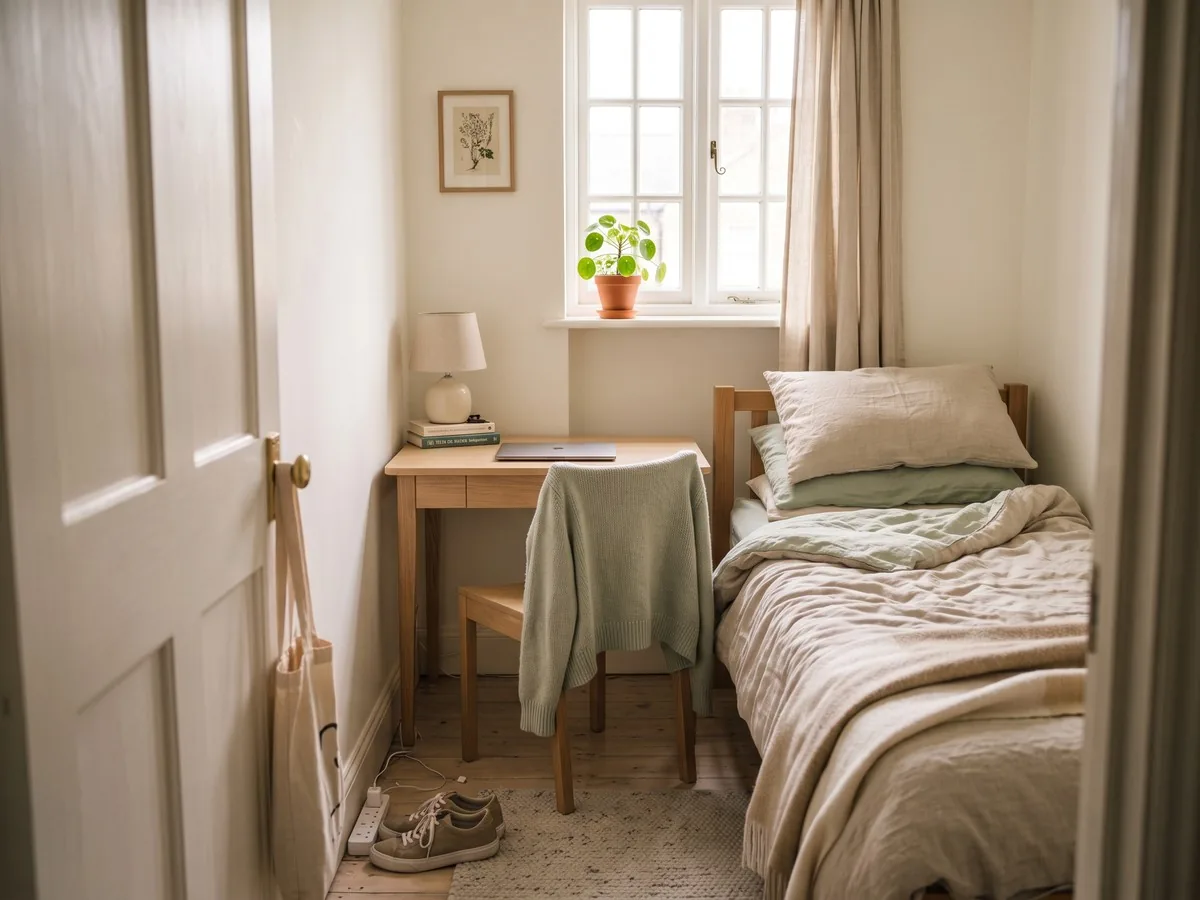
CONCEPT: AI-generated room concept; not a photograph or measured floor plan.
| Placement | Works when | What it costs | Reject it if |
|---|---|---|---|
| Desk as nightstand | Work is occasional and mostly a laptop | The surface is shared with lamp, phone and glass of water | You need the desk clear at night |
| Window wall | The window still opens and the light is usable | Often the longest reach from the door | The chair pull-out blocks the room's main route |
| Foot of the bed | There is genuine chair travel behind you | Turns the end of the bed into a corridor | The chair touches the bed when pushed back |
| Fold-away or movable | Work is temporary and has a defined end | Setting up and packing down every session | You will not actually pack it down |
The table is deliberately not ranked. In a fixed room shell the winner changes with which route you refuse to give up, and that is a decision only you can make.
Use a desk as a nightstand when work is occasional
This is the highest-value option in the smallest rooms, because it takes no new floor at all. One surface does two jobs.
It works when the work is occasional and portable. It stops working the moment the surface has to be clear at night, or the moment the job needs anything left set up between sessions. A nightstand-height surface and a desk-height surface are also not the same thing: the named MICKE example is 29.5 inches tall, which is well above most nightstands, so the piece you choose is doing one job well and the other approximately.
Decide which job is primary and let the other be the compromise. A surface that is bad at both is the common failure here.
Use the window wall only if the window stays usable
The window wall is the instinctive choice and often the right one, but it carries two conditions.
The window has to still open, with the desk and the chair where they will really live. And the curtain or blind has to still work, which is easy to forget at the point of buying and impossible to ignore afterwards.
The second condition is the route. Window walls are usually the furthest point from the door, so the chair's pull-out zone often lands in the middle of the room's main path. Test that with the cardboard, not by imagining it.
Use the foot of the bed only when the chair has somewhere to go
At the foot of the bed a desk can look perfect on a floor plan and be unusable in practice, because the chair reverses into the space you need for walking past.
Sit in the chair. Push back the distance you measured earlier. If the chair meets the bed, the wardrobe, or the only route through the room, this placement is already rejected regardless of how well the desk itself fits.
It works best in rooms with genuine length behind the bed, and it fails quietly in rooms without it, because the desk still fits and only the chair does not.
Choose a fold-away or movable desk for temporary work
A fold-away or movable desk exists to give the floor back. That is its whole value, and it is a real one when the work is temporary and has a defined end.
Be honest about the packing-down step before you buy. If you will not fold it away most days, you have bought a permanent desk with an inconvenient surface, and a fixed desk in a better position would have served you more.
If a desk cannot win any of these four positions, the category may belong on the wall instead of the floor. Compare no drill wall storage for renters, which keeps the same reversible, renter-safe constraint.
Keep, move, or skip
- Keep the placement when the chair completes a full sit-down and stand-up cycle without touching the bed, the wardrobe, or the door swing.
- Move to another placement when the desk fits but the chair only works by moving something else first, because that friction never gets easier.
- Skip the desk entirely when the only workable position blocks the bed route, and put the work surface on the wall or accept that this room is not a work room.
Solve the furniture route before the desk with the small bedroom layout ideas guide. Keep the surface usable after dark with small bedroom lighting ideas for renters. If the desk wins its position but storage then has nowhere to go, work the gap under the bed with under bed storage ideas for small rooms.