
Small Bedroom Lighting Ideas for Renters

The short answer: map the door-bed-wardrobe route first, then put the light outside it. Floor, bedside or rechargeable - no wiring, nothing permanent.
A portable light can make a small bedroom harder to use when its base occupies the walking route, its shade crowds the bedside surface, or its cord crosses the path from the door. Choose the location before choosing the lamp. The first test is movement, not mood.
These small bedroom lighting ideas for renters use a conflict map. Mark the door-bed-wardrobe route, place the light outside it, and reject any setup that needs a cable to cross the room. A floor lamp is the strongest general default when it can stand beyond that route. Bedside and rechargeable options solve narrower problems.
Draw the route that the light cannot enter
Start at the bedroom door and walk to the side of the bed you use. Continue to the wardrobe, then repeat the route while opening the wardrobe and any nearby drawer. Mark the path with paper strips or a loose cord that is not connected to anything. This is a placement map, not an installation method.
Include the full lamp shape in the test. The base can sit outside the path while a wide shade projects into shoulder or hand space. A cable can begin neatly beside the wall and still cut across the doorway before reaching its source. Reject the location if any part of the setup turns a direct route into a step-over or reach-around action.
Compare the placement by conflict
| Placement | Best use | What must stay clear | Reject when |
|---|---|---|---|
| Floor light outside the route | Movable general room light | Door swing, bed approach, and wardrobe opening | The base or shade enters the route |
| Bedside portable light | Reading surface or local glow | The usable top of the bedside piece | The lamp leaves no landing space for daily items |
| Desk light | Focused light at a temporary work surface | Chair movement and the route behind it | The cable crosses the room or the shade blocks the work area |
| Rechargeable category | A location where a cable route fails | A stable surface outside the movement path | The product footprint still crowds the route |
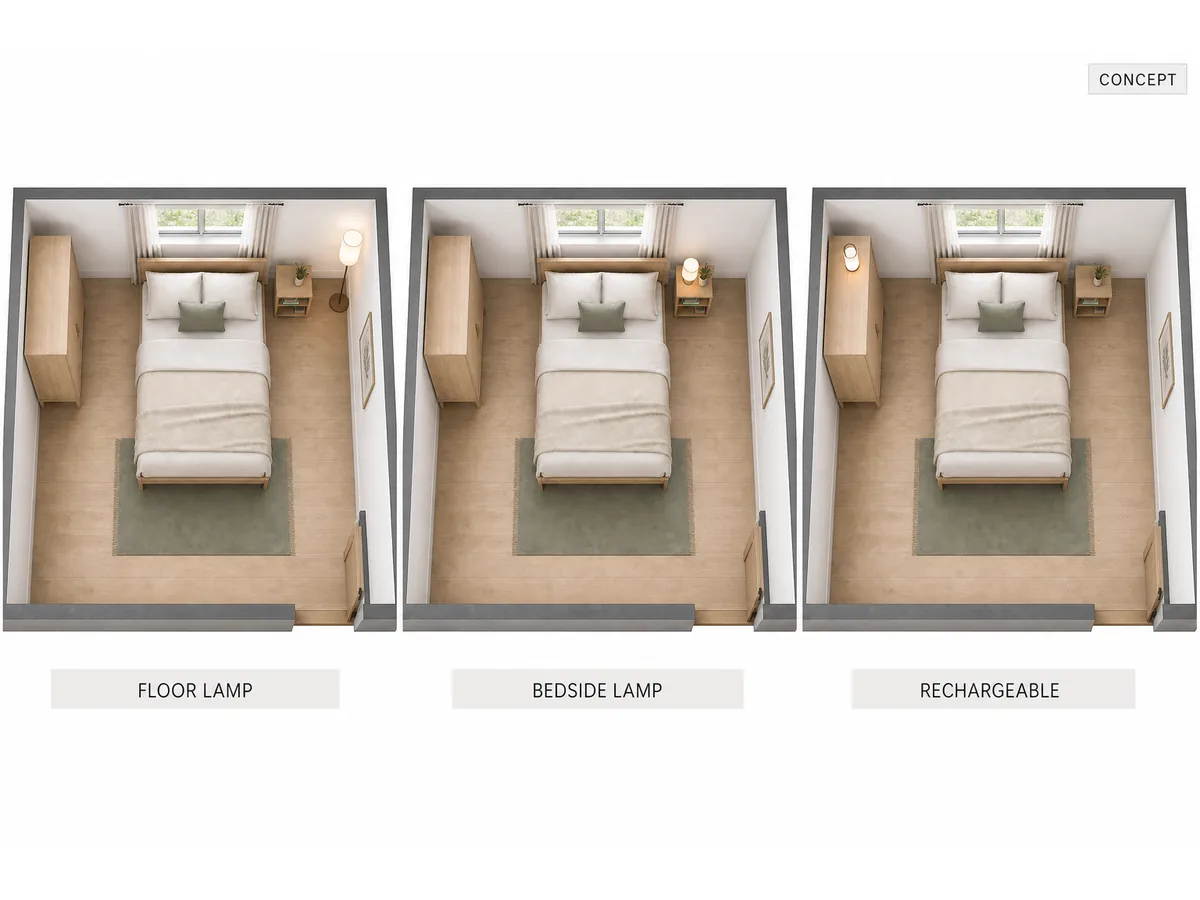
CONCEPT: AI-generated room concept; not a photograph, measured floor plan, or lighting-performance claim.
Put the general light beyond the route
A floor light works well as the first movable layer because it does not consume the bedside or desk surface. Place its base in a quiet edge of the room, then inspect the shade from the doorway and while opening storage. The winning location remains visually present without becoming another object to navigate.
Do not hide a poor cable route behind the bed or a rug. If the source location forces the cable across the movement map, move the lamp or choose a category that does not require that route. This page does not advise on permanent work; it stays with movable products used according to their current instructions.
Protect the bedside landing space
A bedside lamp loses when it takes the entire surface. Keep room for the items you actually place there, then check whether the shade projects over the bed or route. A wall-mounted look may appear cleaner in a photograph, but a renter does not need to copy that installation to keep the function.
Use the real product footprint in the paper test. One current product example, the IKEA NODMAST portable lamp, is listed at 10.25 inches high with a shade diameter of 7 inches. Its listing also states a luminous flux of 50 lumens. Those figures describe that lamp only. The dimensions do not prove that it fits a particular table, and the lumen rating does not prove that it provides enough light for a room.
Keep desk light inside the desk zone
Place a desk light so its base, shade, and cable remain inside the work zone. Pull the chair out, sit down, stand up, and walk behind it. If the setup needs a cable to cross the bedroom route, the location fails even when the desk itself fits.
A clip-on or compact portable category may preserve more surface, but the exact product still needs its own support and use instructions. Avoid turning a temporary work surface into a permanent tangle. The desk should be able to return to another use without rewiring the room.
Use rechargeable only when it solves the cable conflict
A rechargeable category is useful when the desired light location has no clean cable route. That does not automatically make every placement good. The base and shade still occupy space, and the product still needs a stable location where it can be used as directed.
Choose this category because it removes a specific movement conflict, not because it looks minimal. Keep charging and runtime claims out of the decision unless they are checked against the exact current product. For the first layout pass, footprint and route are enough.
Run the movement check
- Walk from the door to the bed without changing stride or stepping over anything.
- Open the wardrobe and nearby storage while every lamp remains in place.
- Confirm that bedside and desk surfaces still perform their main task.
- Reject a placement when its base, shade, or cable crosses the fixed route.
- Photograph the accepted paper map before buying a product.
Build the route first with the small bedroom layout ideas guide. Keep storage pulls outside the same path with under bed storage ideas for small rooms. When floor space cannot take another object, compare no drill wall storage for renters without assuming any method is damage-free. If the light is for a work surface, settle where the desk and its chair actually go first with small bedroom desk layout ideas.