
Under Bed Storage With a Center Support Beam
The short answer: a center support turns one opening into two. Once that is true the number that decides your purchase is no longer the published height. It is the width of the opening on one side of the beam, and that number appears on no spec sheet.
A spec sheet describes the furniture. It does not describe the space underneath it, and on a bed with a center support those are two different shapes.
IKEA publishes the MALM Full frame at 8.25 inches of height under the furniture and 59 inches wide. Read as numbers to shop by, that sounds like one generous rectangle. It is not a rectangle. The same page lists what comes in the box, and one of the items is a center support beam, which IKEA describes as required for the stability of the bed frame.
So the space under that particular bed is not one opening. It is two.
CONCEPT: AI-generated room concept; not a photograph or measured floor plan.
The published height stops being the number that decides
Height is what every under-bed guide leads with, and on an unobstructed frame it is the right number. A center support changes which measurement is binding.
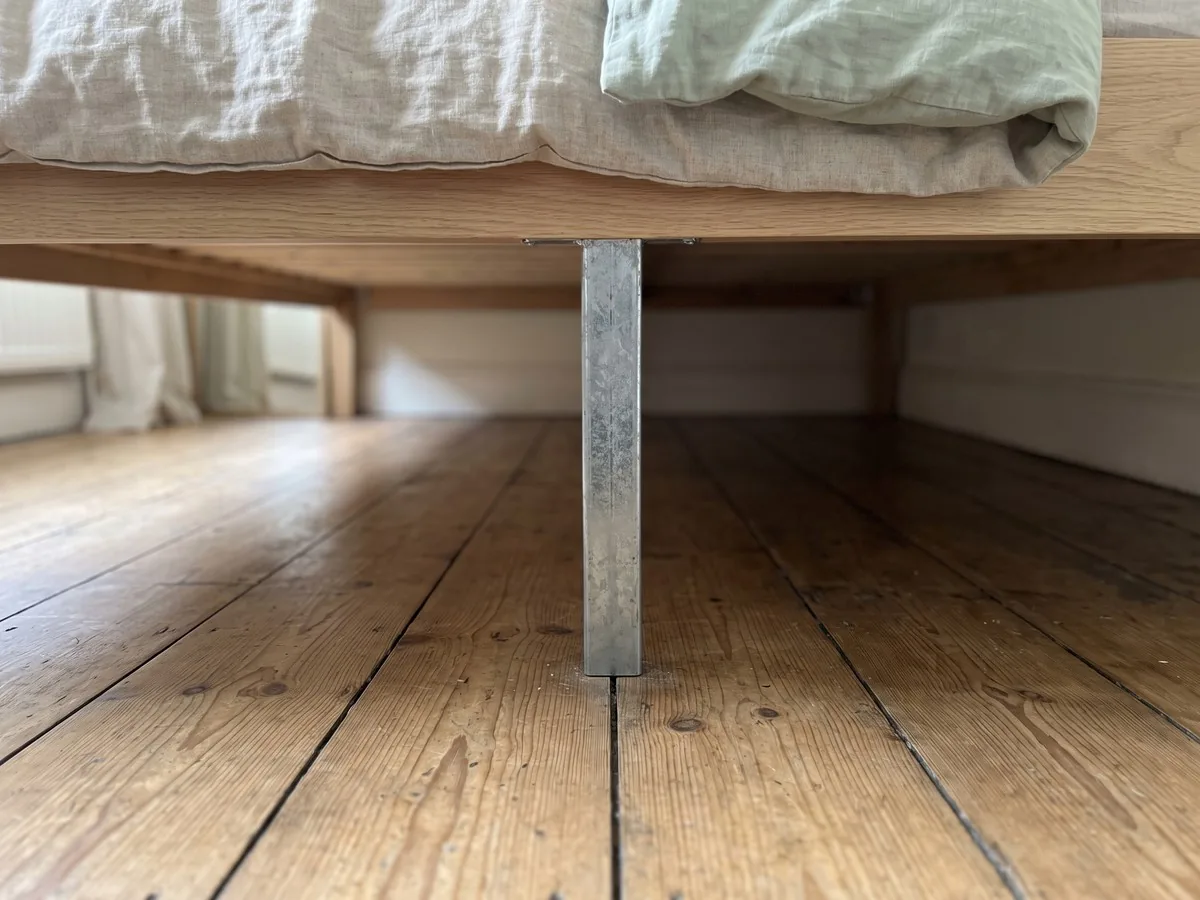
IKEA publishes the SKORVA beam at 2.75 inches wide and 2.375 inches tall. Those figures describe that one named part and prove nothing about any other frame's hardware. They are enough to make the point: the middle of the space is occupied by something with real dimensions.
Once that is true, a container no longer has to fit under the bed. It has to fit beside the beam. And the width beside the beam is printed nowhere.
The 59 inches is the outside of the furniture
This is the trap worth naming plainly. A published width describes the frame edge to edge, rails and finish included. It is not the width of the opening underneath, and it is certainly not the width of one of the two openings a beam creates.
You also cannot get there by subtracting the beam's 2.75 inches from the 59 inches. Rails have thickness, legs sit in the corners, and the two sides are not always equal. The only honest route is to measure the opening itself.
Find which way your beam runs before you measure anything
SKORVA is telescoping, published from a minimum of 54.75 inches to a maximum of 79.875 inches. That is a bar long enough to span a double bed in one direction, and which direction it spans on your frame is something only your frame can tell you.
It matters because it decides the shape of the two openings. A beam running head to foot leaves a long narrow space on the left and another on the right. A beam running side to side leaves a shallow space at the head and another at the foot. The same container succeeds in one case and is unbuyable in the other.
Get on the floor with a light and follow the beam end to end. Note where its supporting leg lands. A leg is a second obstruction, and it is the one people miss.
Measure the opening, not the bed
- Pick one side of the beam. That side is now the whole project, and the other side is a repeat of it.
- Measure from the inside face of the side rail to the near face of the beam.
- Take that reading again at both ends and again at the leg, then keep the smallest of the three.
- Measure the height at that same narrowest point, not in the middle of an open span.
- Write both numbers down before you look at a single product.
Then compare the numbers against the container rather than against the marketing. IKEA publishes the SKUBB storage case at 20.75 inches deep, as one named example. On a beam running head to foot, that 20.75 inches is what has to clear between the rail and the beam, and it is a larger number than most people expect to have.
What a beam does to each container type
| Container | What a center support does to it | Keep or reject |
|---|---|---|
| Rigid bin or drawer | Cannot bend around the beam or its leg, so the narrowest point decides everything | Keep only if the whole box clears the smallest of your three width readings |
| Soft case | Gives slightly against the beam, and can be filled after it is in place | Usually the strongest option once a beam exists |
| Shallow tray on wheels | Passes under a beam mounted high, jams against one mounted low | Test with cardboard before buying more than one |
| One large container | The beam has already decided this | Reject, and buy two narrow ones instead |
The consequence is a shopping change, not only a measuring one. A beam means buying two narrow things rather than one wide thing, and two narrow cases usually cost more than one wide case for the same volume. Budget for that before you are annoyed by it.
Does the beam cost you height as well
Sometimes, and only your own frame can answer it. The beam is 2.375 inches tall, but whether that height hangs below the slats, sits level with them, or tucks up inside the rails differs between frames.
Do not assume either way. Cut a piece of cardboard to the height of the container you are considering and slide it along the full route it would travel, including past the beam and its leg. If the cardboard catches, the container will catch.
Do not work around a beam by removing it or by resting a container on it. It is part of the frame, and on the named example above IKEA states it is required for the frame's stability.
Keep, move, or skip
- Keep the container when it clears the narrowest width reading, completes the whole route past the leg, and comes back out on the side you actually stand on.
- Move to two narrower soft cases when a single rigid box only fits on paper.
- Skip the space when both openings are too narrow to be worth the money, and put the category on the wall instead.
If the gap is tight in height rather than divided in width, work from a height budget with under bed storage for low clearance frames. If the floor is what fights you, see under bed storage on carpet. For the wider comparison of drawers, bins, bags and lift-up frames, start at under bed storage ideas for small rooms. And take the numbers with you using the under-bed measurement worksheet.