
Under Bed Storage for Low Clearance Frames
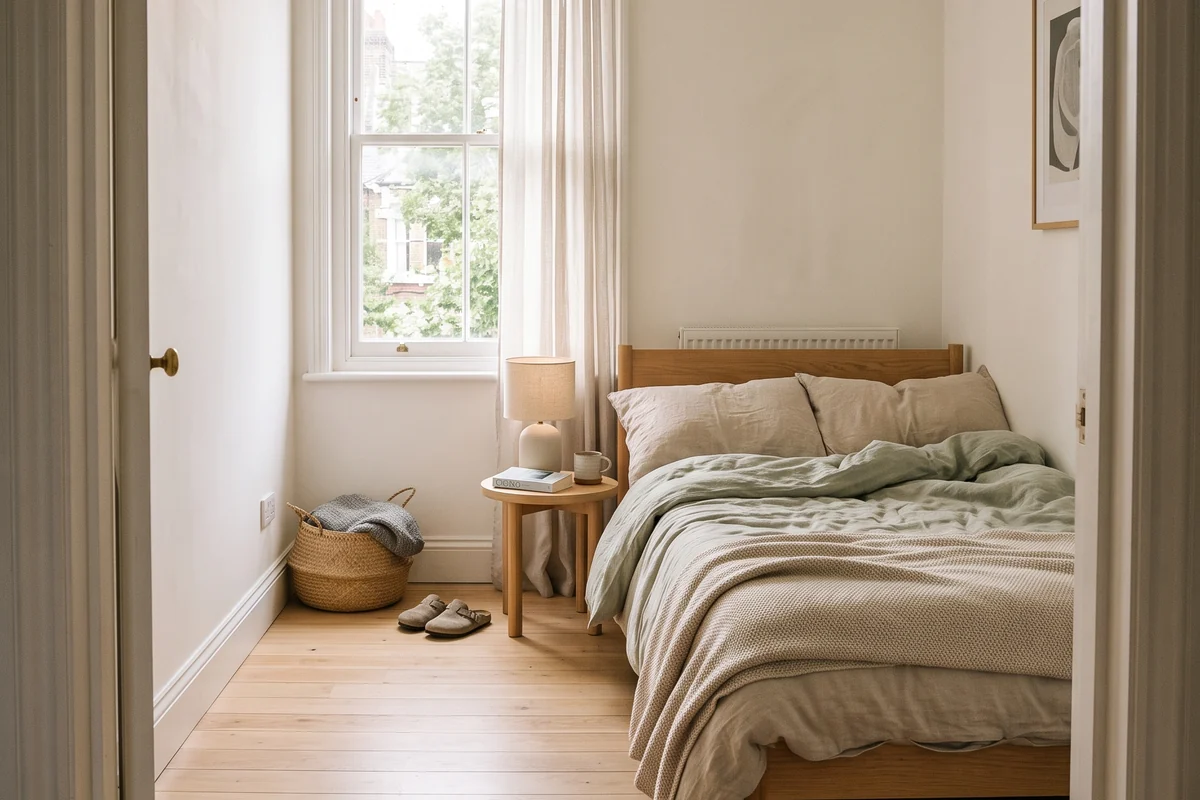
The short answer: your clearance is not the number printed on the bed frame. Measure four points, subtract what carpet, the lid and the handle take, and shop against what is left.
Most under-bed storage that fails does not fail by a wide margin. It fails by a sliver, at one point along the frame the buyer never measured, usually while it is already half way in and loaded.
Consider two figures both published by the same retailer. IKEA lists the NEIDEN Full bed frame at 7.875 inches of height under the furniture. IKEA lists the SKUBB storage case at 7.5 inches tall. Those figures describe those two named products only, and neither proves anything about your bed or your bin. But set side by side they show the shape of the problem: the gap between a common budget frame and a common soft case is three eighths of an inch, before the room has taken anything back.
This guide turns that sliver into a number you can shop against.
Measure at the tightest point, not the obvious one
The measurement almost everyone takes is at the side rail, near the middle of the bed, because that is where a hand fits easily. On many frames that is the most generous point in the whole opening.
Take the tape underneath and check four places instead:
- Each corner leg, where a foot or bracket may sit lower than the rail.
- The centre support, if the frame has one. Full and queen frames often carry a centre leg or cross member that is invisible from the side.
- The entry side, at the exact point the container would cross.
- The far side, where a container has to finish its travel.
Write down the smallest of the four. That number, not the average and not the one at the side rail, is your clearance. Everything after this works from it.
If the tape catches on fabric before it reaches the floor, note that too. A bed skirt, a loose mattress cover, or a corner of a duvet reduces the working opening even though it will not show up on any measurement.
Build the height budget
Your clearance is the ceiling. Four things spend it before the container ever arrives.
| What spends it | Why it does | How to account for it |
|---|---|---|
| Carpet compression | Pile springs back under an empty bin and gives way under a loaded one, so the box sits lower going in than coming out | Press a loaded container down onto the pile and measure again at that height |
| Lid stack | A recessed lid adds nothing; a lid that sits proud of the rim, or clips over it, adds its own thickness | Measure the container closed and loaded, never open and empty |
| Handle rise | Straps lie flat, moulded grips do not; a raised handle is often the single highest point of the whole container | Measure across the handle, not across the lid |
| Lowest cross member | The frame's own hardware is usually the real ceiling, and it sits where you cannot see it | Use the smallest of the four measurements above |
Subtract those from the clearance and you have the height budget. Shop against that figure, not against the one printed on the frame.
The margin is normally smaller than people expect. Reading the two published figures again, a case at 7.5 inches under a frame at 7.875 inches leaves three eighths of an inch of headroom on paper. A pile carpet under load, or a moulded handle, will take that back on its own.
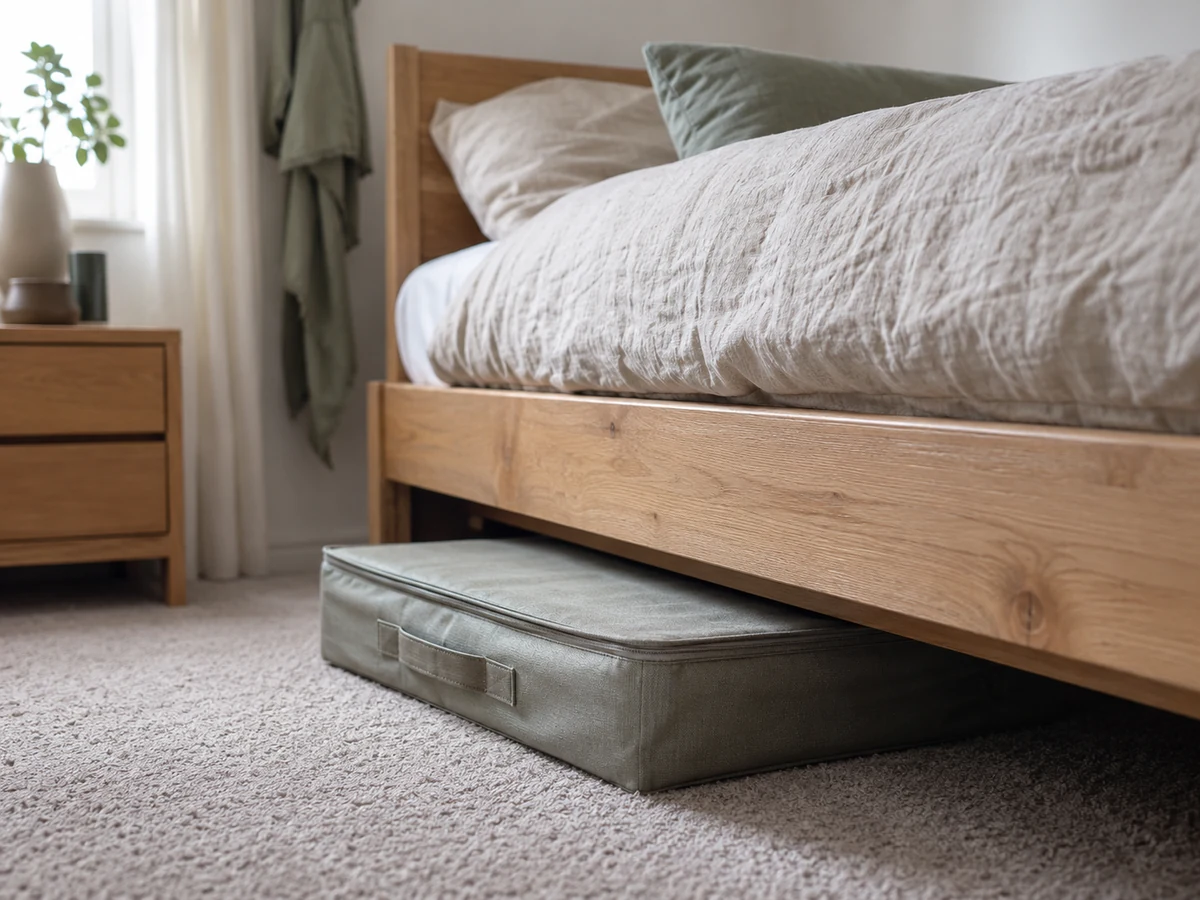
CONCEPT: AI-generated room concept; not a photograph or measured floor plan.
Match the container to the budget
Once the budget is a number, the container types sort themselves.
- Soft cases are the strongest default on a tight budget. The sides give, so a case that is marginally over can still pass, and the same case comes back out under load without needing the extra headroom a rigid box demands. The cost is that contents are harder to scan and the shape changes as the case moves.
- Rigid shallow bins protect better and stack cleanly before loading, but they spend the whole budget at once. A rigid box either clears every point along the route or stops. There is no partial success.
- Wheeled bins are the wrong instinct on a low frame. The wheels sit below the box, so the base is added to the height rather than subtracted from the effort, and on carpet the wheels sink and give the height back anyway. Reach for wheels when the clearance is generous and the floor is hard. If your floor is carpeted, that trade is worked through in full in under bed storage on carpet.
- Flat trays and sliders win at the extreme low end, where nothing with a lid will pass. Accept that the contents are exposed and choose the category accordingly.
Buy one before buying four. The single most common way this goes wrong is a set of matching bins bought on the strength of a measurement taken at the side rail.
Check the pull path, which fails on its own
Height and travel are separate problems, and a container can pass one while failing the other.
The SKUBB case is 20.75 inches deep. That is how far it has to come out of the gap before the lid clears the bed and the contents become reachable. Stand at the entry side with the wardrobe, the nightstand, and any door in their normal positions, and measure the clear floor you actually have. If the free run is shorter than the container is deep, the storage works only when the room is rearranged first, which means it does not work.
Rehearse it with a piece of cardboard cut to the container's footprint before anything is bought. Push it in, pull it out, and do it from the side you would really use, at the time of day you would really use it.
Keep, move, or skip
- Keep the container when its closed, loaded height fits inside the height budget and it completes one full pull without another piece of furniture moving.
- Move the category to a different container type when the budget rules out the lid, or when the pull path is shorter than the container is deep.
- Skip the purchase when the smallest of your four measurements is uncertain. Measure again rather than buying to find out.
If the category simply cannot live under this bed, put it on the wall instead with no drill wall storage for renters. If the pull path is the thing that failed rather than the height, the problem is the room and not the box, so start with small bedroom layout ideas. If the height is fine and something still refuses to go in, look for a beam running through the middle of the space: see under bed storage with a center support beam. For the wider choice between drawers, bins, bags, and lift-up frames once clearance is no longer the binding constraint, use the under bed storage ideas for small rooms guide.