
Under Bed Storage on Carpet That Still Slides
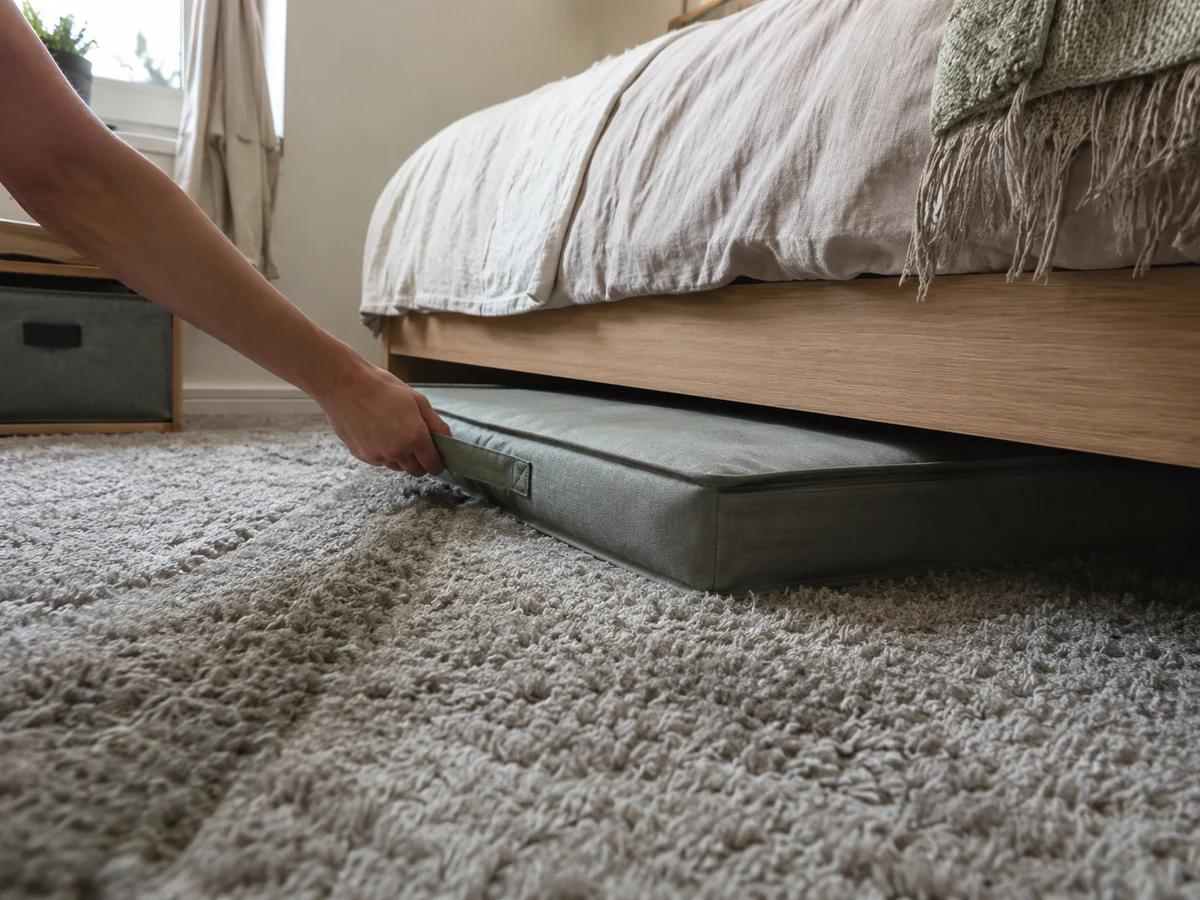
The short answer: on deep carpet, wheels cost you height and then refuse to roll. A soft case usually pulls easier than anything on castors, and the ranking flips on a hard floor.
Carpet does not just make under-bed storage harder to pull. It changes which container you should buy, and it does so in the opposite direction to most advice.
The instinct on a soft floor is to reach for wheels. On carpet that instinct is usually wrong, and it is wrong twice over: the wheels take a share of a height budget you cannot spare, and the pile then refuses to let them roll.
Price the wheels before you choose them
Wheels are not free. They sit under the box, so their height comes out of the same gap the storage has to fit through.
IKEA publishes the VARDO under-bed box at 7.125 inches of overall height, with the inside of the drawer at 5.125 inches. Those figures describe that one named product and prove nothing about any other box. But the distance between them is instructive: the base, the shell and the castors account for the difference, and none of it holds anything.
Set that against a case with no wheels at all. IKEA publishes the SKUBB soft case at 7.5 inches tall, and almost the whole of that height is doing storage work.
So the trade is visible before you buy. A wheeled box spends part of a scarce gap on a mechanism. That spend is worth making on a hard floor, where the mechanism works. On deep pile it buys very little.
Understand what pile does to a wheel
A wheel works by concentrating load onto a small contact patch so the floor can be crossed with less effort. Carpet defeats that by yielding under exactly that patch.
- Small hard castors sink into pile. The wheel stops rotating and starts ploughing, which is heavier than dragging a flat base would have been.
- Wide soft casters cope better on short pile because the load spreads over more fibre, but they are also taller, so they cost more of the height budget.
- A flat rigid base drags, and on pile that drag is real, but it is predictable and it never jams.
- A soft fabric base glides on its own weave and conforms to the surface instead of fighting it. On pile this is usually the least effort of the four.
The ranking inverts on hard floors. That is the point: there is no universally correct base, only a base matched to a floor.
Run the loaded pull test before buying
Container copy is written for a showroom floor. Your carpet is the only test that counts, and you can run it with something you already own.
- Load a box, a crate, or a stacked pile of books to roughly the weight you intend to store.
- Put it on the carpet in the position the container would occupy under the bed.
- Pull it out along the exact route you would really use, from the side you would really stand on.
- Do it again with the wardrobe door and the nightstand in their normal positions.
- Then push it back in, which is the direction people forget to test and the one that fails more often.
If a loaded weight already drags badly on bare pile, wheels are not going to rescue it. If it slides acceptably, you have your answer without spending anything, and a soft case will do.
Compare the options against your own floor
| Base type | Deep pile | Short pile | What it costs |
|---|---|---|---|
| Small hard castors | Sinks and ploughs; avoid | Workable if the load stays light | Height, taken from a gap you may not have |
| Wide soft casters | Better, still effortful | Good | The most height of the four |
| Flat rigid base | Predictable drag, never jams | Fine | Nothing extra, but no help either |
| Soft fabric case | Usually the lightest pull | Good | Nothing; the shape gives instead |
Choose one and test it before buying a matching set. A set of four bought on the strength of a showroom demonstration is the most expensive way to learn what your carpet does.
Protect the floor without hiding the problem
Hard plastic castors can mark or press a floor over time, and a renter carries that risk. Felt pads and caster cups are the reversible responses, and they are worth adding before first use rather than after a mark appears.
Be honest about what they do, though. A pad softens contact; it does not make a wheel roll on pile. If a container needs pads to be tolerable and still drags, the pads are covering a decision that should be changed instead.
Check the specific product's own instructions before adding anything to its base, and keep every modification removable. No method here is guaranteed damage free, and the state of your particular floor is yours to judge.
Keep, move, or skip
- Keep the container when a loaded test pull along the real route feels easy in both directions on your actual carpet.
- Move to a soft case when a wheeled box passes the pull test but the wheels have eaten height you needed for the frame.
- Skip the purchase when the loaded test drags badly whatever the base, because that is the floor speaking and no container will overrule it.
If the gap under the frame is the binding constraint rather than the floor, work from a height budget instead with under bed storage for low clearance frames. If the container cannot live under this bed at all, move the category to the wall with no drill wall storage for renters. If a beam runs through the middle of the space as well, the floor is no longer the only thing working against you: see under bed storage with a center support beam. For the wider comparison of drawers, bins, bags, and lift-up frames, start at the under bed storage ideas for small rooms guide.